What is an AI Beauty Software? Your Complete Guide

Beauty shoppers want answers fast. They want to know if the foundation matches their skin tone before checkout, if the serum will actually help with dark spots, or if the hair treatment suits their texture.
But here's the problem: most brands can't deliver that certainty. Customers bounce between websites and stores, getting different advice at every turn. They buy the wrong shade, return products, and lose trust in recommendations.
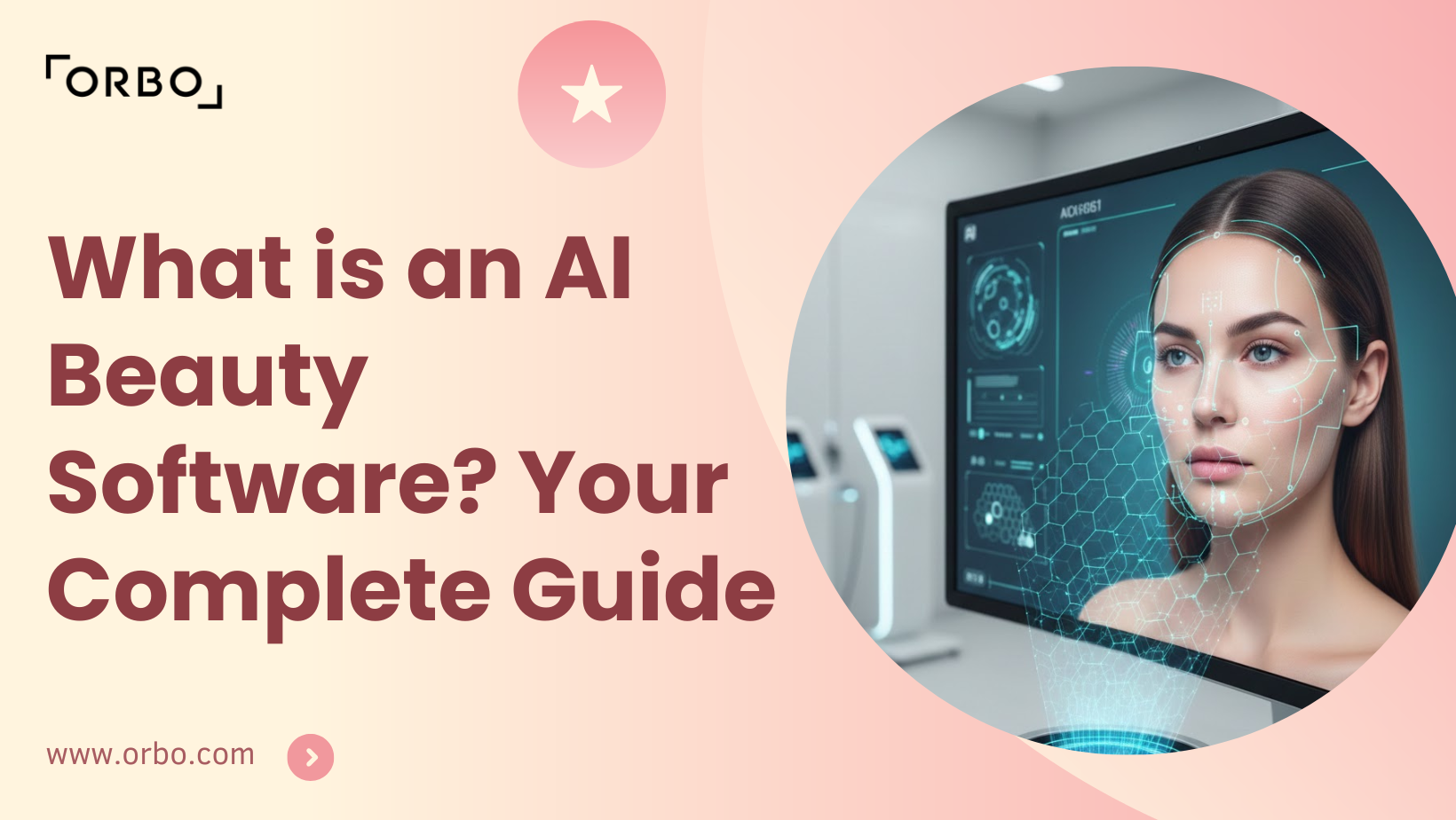
AI beauty software fixes this disconnect. It scans faces, reads preferences, and serves up exact-match products whether your customer is browsing at midnight or standing in your store at noon.
This article explains how AI beauty software works, where it fits in, what results it delivers, and why Orbo AI stands out.
Key Takeaways
- AI beauty software analyzes facial features and purchase behavior to personalize skincare, makeup, and haircare recommendations
- You can deploy it across websites, mobile apps, in-store kiosks, and smart mirrors
- Brands see better conversion rates, fewer returns, and higher customer rebooking
- Orbo AI offers an integrated platform that works for ecommerce, retail, and salon environments
- Privacy controls, inclusive training data, and measurable KPIs make or break adoption
What Exactly Is an AI Beauty Software?
AI beauty software is a technology system that analyzes visual and behavioral data to personalize recommendations for skincare, makeup, and haircare. Think of it as a digital advisor, one that’s trained to understand the nuances of facial features, hair textures, and user preferences.
It doesn't just guess. It scans live images or selfies, compares them against a massive dataset of skin and hair conditions, and then maps that to your catalog to recommend the most suitable products.
The result? A seamless match between what the user needs and what the brand offers is delivered instantly, 24/7.
Orbo AI’s software suite allows beauty brands to manage diagnostics, virtual try-ons, recommendations, and customer profiles in one place eliminating the need for multiple tools or integrations.
How Does AI Beauty Software Work Behind The Screen?
Building a seamless, personalised journey takes more than a selfie scanner. AI beauty platforms combine image recognition, product metadata, and behavioural insights to power product and service recommendations across channels.
This section covers the core components of how AI beauty platforms work from engine training to data inputs, live outputs, and how they link to your existing infrastructure.
Core AI Engines for Virtual Try-On, Skin, and Hair Analysis
At the heart of every AI beauty system are computer vision models trained to detect and interpret skin and hair features with remarkable precision. These engines are developed using large datasets of annotated images that reflect real-world diversity across skin tones, lighting, genders, and hair types.
They are capable of identifying:
- Acne, fine lines, hyperpigmentation, and pores
- Hydration levels, oiliness, or redness
- Hair texture, frizz, thinning, or breakage
- Facial geometry for realistic makeup try-ons
Once a user initiates a scan, the engine reads their condition and compares it with product databases to recommend best-fit options. Orbo’s Skin Scan Pro and Virtual Makeup are two such examples. The former delivers clinical-grade skin insights, while the latter offers 3D cosmetic overlays for lips, eyes, and face.
According to Statista, the global beauty tech market, which includes AI-driven skincare solutions, is projected to reach nearly $8.9 billion by 2026, fueled by demand for customization, contactless experiences, and tech-powered personalisation. This projected growth reflects how critical AI has become to helping shoppers make smarter, faster beauty decisions in both physical and digital settings.
Data Sources It Learns From: Selfies, Scans, Purchase History, and Feedback
Accuracy in AI beauty software improves over time. The more it learns about the user, the better it gets at making relevant suggestions. This learning happens across several types of input:
- Visuals from selfies or live camera scans
- Historical purchase and Wishlist activity
- Customer feedback, like reviews, returns, and ratings
- Skin log entries over time
With this data, the system adapts. If a user has previously returned products containing niacinamide, future recommendations will avoid it. If they always choose lightweight formulas, the AI will prioritise those.
From Model Training to Real-Time Recommendations on Site and in Salon
The AI journey happens in stages:
In practice, this means a customer can scan their face on a mobile app and receive a skincare regimen. That same profile can be used in-store by a stylist to suggest a service or treatment that complements their digital routine.
Typical Integrations With E-Commerce, CRM, POS, and Booking Systems
AI beauty software works best when it’s part of your overall tech stack. Here’s where it usually plugs in:
- E-commerce platforms to deliver on-site try-ons and personalised routines
- CRM tools to tailor campaigns to individual skin/hair profiles
- POS systems to log in-store purchases tied to scan results
- Booking software to recommend services during check-in or rebooking
Orbo AI’s solutions, like Virtual Hair Color, are built to support modular deployment and plug-and-play setup with common platforms like Shopify, Salesforce, or Lightspeed.
Where Does AI Beauty Software Fit In Your Brand And Salon Experience?
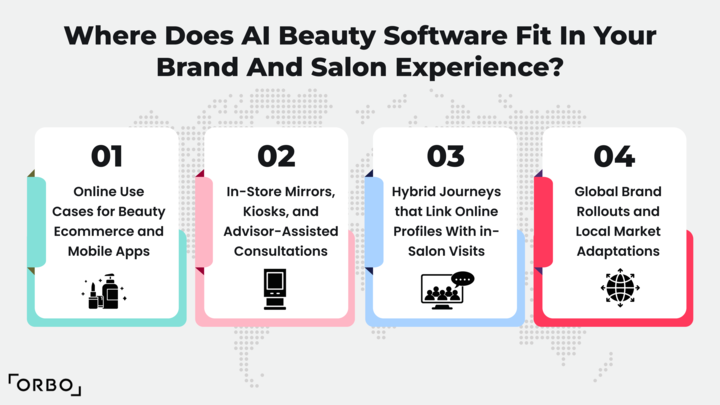
Where customers interact with your brand online or offline is where AI should live. Beauty brands today need software that works across channels and connects customer data at every step.
This section explores how AI beauty tools function in ecommerce, physical stores, hybrid journeys, and global contexts.
Online Use Cases for Beauty Ecommerce and Mobile Apps
In digital environments, AI software makes product discovery and selection easier. Selfie scans can trigger dynamic product bundles, virtual makeup overlays help customers visualise looks, and smart routines replace static quizzes. These experiences can be launched from product pages, category pages, or even landing pages.
Mobile apps further add convenience by letting users track progress, get refill reminders, or share scan results. Brands can drive re-engagement through push notifications, gamified routines, or loyalty offers tied to the AI results.
In-Store Mirrors, Kiosks, and Advisor-Assisted Consultations
Retailers and salons can use smart mirrors and tablets for walk-in diagnostics, shade matching, and product demos. These devices support both self-service and advisor-led consultations.
For example, Smart Skin Analysis solution lets customers scan their face, see real-time skin readings, and receive curated recommendations all without opening a jar. For staff, tablet-based apps help advisors run scans and show results during appointments.
Hybrid Journeys that Link Online Profiles With in-Salon Visits
AI beauty platforms can connect user profiles from the web to physical locations. This ensures a consistent journey. Whether a customer starts on your site or in a salon, their data scan results, preferences, and purchase history stay intact.
Orbo enables QR-based or login-based sync across locations, so advisors can view recent skin changes, past purchases, and personalised suggestions.
Global Brand Rollouts and Local Market Adaptations
Global beauty brands often need to localise AI for skin tone ranges, climate-specific recommendations, and regional preferences. Orbo’s system supports this through modular architecture and rule-based logic.
For example, foundation matchers in India may prioritise golden undertones, while K-beauty rollouts in Korea may focus on hydration and glow. Environmental stressors like humidity or UV exposure can also be factored into the logic.
What Business Results Can AI Beauty Software Deliver?
AI beauty software creates a measurable impact across ecommerce, retail, and salon operations.
Impact on Conversion Rate, Average Order Value, and Repeat Purchases
AI helps shoppers commit with more confidence, leading to:
- 25–30% increase in online conversion
- 15–20% rise in AOV through bundled suggestions
- Shorter repeat cycles due to better product fits
Effects on Appointment Value, Stylist Productivity, and Rebooking Rates
Stylists use AI to quickly assess customer concerns and recommend services with data-backed confidence. This:
- Increases consultation speed
- Supports personalised product and treatment plans
- Helps track post-service outcomes for better follow-ups
Reducing Returns, Sampling Waste, and Mis-Matched Purchases
Virtual try-ons and AI diagnostics help reduce trial-and-error shopping. Brands see:
- Up to 20% reduction in foundation and skincare returns
- Fewer mismatched samples sent out
- Better ROI on sampling campaigns
KPIs CXOs Track: Revenue Lift, Margin, and Customer Lifetime Value
At the leadership level, AI software drives:
- More revenue per customer
- Higher retention through personalised journeys
- Margin protection via fewer returns and improved rebooking
Orbo’s executive dashboards allow tracking across campaigns, categories, and store formats in real time.
How Should Beauty Leaders Evaluate AI Beauty Software Vendors?
Selecting a software partner requires understanding both their technical capabilities and their alignment with your brand’s CX goals.
Feature Checklist for Ecommerce Brands, Retail Chains, and Salons
Accuracy, Inclusivity, and Fairness in Skin and Hair Analysis
Check that the vendor supports:
- Diverse skin tone recognition
- Hair texture differentiation
- Bias mitigation and fairness reporting
Ask for validation reports and inclusivity testing before rollout.
Privacy, Consent Management, and Regulatory Compliance for Facial Data
Look for:
- GDPR/CPRA compliance
- Data minimisation and encryption
- Consent-first workflows
- Audit trails and access logs
Integration Effort, Change Management, and Internal Training Needs
Ask vendors about:
- Set up time and effort
- Existing platform compatibility
- Onboarding plans for retail and e-commerce teams
Orbo AI offers SDKs and integration playbooks to ease adoption across functions.
Pricing Models, Contracts, and Questions to Ask in Vendor Demos
Ask about:
- Licensing: user-based, scan-based, or location-based?
- Access to analytics dashboards
- Contract terms: flexibility, renewals, service-level guarantees
- Customisation support
Always request a demo tailored to your actual catalogue and workflows.
What Does A Future-Ready AI Beauty Setup Look Like?
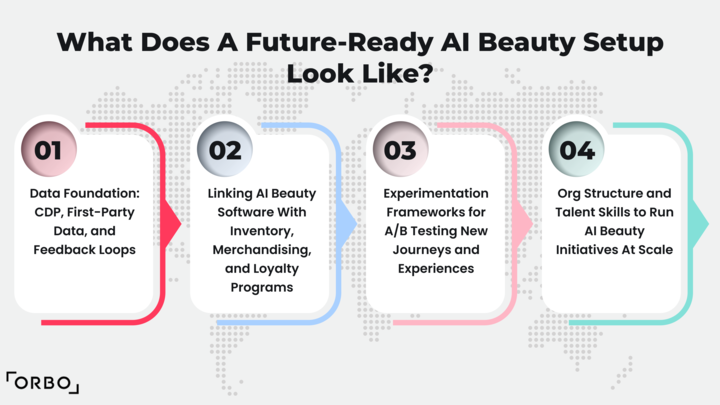
Future success in AI beauty depends on the infrastructure behind the scenes. Brands need reliable data flows, cross-functional teams, and experimentation frameworks.
Data Foundation: CDP, First-Party Data, and Feedback Loops
Ensure your AI setup includes:
- Unified customer profiles
- Scan and usage data stored over time
- Feedback tied to product performance
Linking AI Beauty Software With Inventory, Merchandising, and Loyalty Programs
Integrate AI logic with:
- Live inventory feeds to avoid stockouts
- Merchandising rules (e.g., seasonal offers)
- Loyalty systems for personalised rewards
Experimentation Frameworks for A/B Testing New Journeys and Experiences
Test different experiences:
- Static vs AI-generated routines
- AI scan vs manual filters
- Virtual try-on vs photo swatches
Org Structure and Talent Skills to Run AI Beauty Initiatives At Scale
Ensure alignment across:
- Digital and product leads
- CRM and data science teams
- Retail staff and in-store trainers
Why Choose Orbo AI as Your AI Beauty Software Partner?
AI beauty isn’t just about scanning faces or matching shades; it’s about building confidence, loyalty, and consistency across every touchpoint. That’s where Orbo AI stands out.
It brings together speed, inclusivity, and technical precision in one unified platform. Whether you’re helping a first-time shopper online, guiding a returning salon customer, or scaling retail rollouts across countries, Orbo makes it all feel seamless.
From the customer’s first scan to their second purchase or rebooking, Orbo AI ensures the experience is smart, relevant, and easy to act on. For brands, that means less friction, lower returns, and better outcomes across the board.
Orbo AI’s Core Strengths for Skin, Hair, and Makeup Journeys
Orbo’s suite of AI modules covers every major beauty concern, backed by dermatology-grade research, fast response times, and inclusive datasets.
- Smart Skin Analysis: Uses real-time computer vision to detect conditions like acne, pigmentation, dryness, and more, delivering clinical-grade analysis in seconds. Ideal for both e-commerce and salon use.
- Virtual Makeup Try-On: Offers high-accuracy simulations of lip, eye, and face products, adapting to lighting, skin tone, and facial geometry for a realistic preview.
- Virtual Hair Color: Applies advanced segmenting and colour‑mapping to let customers preview different shades in real time and then guides them to the exact dye option that complements their skin undertone and style.
These AI capabilities don’t live in silos; they work together to power full beauty journeys across skin, hair, and makeup.
How Orbo AI Supports Ecommerce Brands, Retailers, and Salons in One Platform
With Orbo, you’re not locked into a one-size setup. The platform is modular and works across channels:
- For E-commerce: Lightweight widgets and APIs plug into Shopify, Magento, and custom stacks. You can launch virtual try-ons, skincare advisors, and quizzes with minimal engineering.
- For Retail Stores: Smart mirrors and kiosks offer walk-in diagnostics and try-on experiences, reducing reliance on testers or floor staff.
- For Salons: Tablet interfaces allow stylists to run real-time scans, recommend treatments, and upsell products without guesswork.
- For Managers: Real-time dashboards show what’s happening across locations, most-used features, top-converting shades, or trends in customer preferences.
This multi-surface architecture makes it easy for brands to deploy fast, adapt locally, and manage centrally.
Business Results that Matter to CXOs
Orbo isn’t just cosmetic tech; it drives hard numbers:
- Better conversions through guided and confident shopping
- Fewer returns and lower rebooking costs thanks to accurate fits and service matching
- Higher customer lifetime value (LTV) through personalised routines, reorders, and loyalty triggers
Whether you’re reporting to marketing, product, or retail leads, Orbo helps tie AI directly to performance KPIs.
Omnichannel Rollouts With Smart Mirrors, Kiosks, Apps, and Websites
Most customers don’t stick to one channel. Orbo’s software makes sure their profile, scan data, and preferences follow them from app to store and back.
A customer might start by scanning their face on a brand’s app, try on a lipstick shade virtually, and later walk into a retail store where a smart mirror picks up the same profile to complete the experience. Stylists, store staff, or even kiosks can pick up where the app left off.
Consistency like this isn’t just convenient; it builds trust and encourages repeat visits.
Privacy, Security, and Inclusivity Commitments from Orbo AI
Facial and skin data are sensitive, and Orbo treats them with care:
- Fully GDPR and CPRA compliant, with clear opt-in flows and data controls
- Scan data is anonymised and never stored unless explicitly required by the brand, with consent
- Fairness audits ensure that recommendations work across all skin tones, genders, and regions, avoiding bias in analysis or try-on
Orbo AI invests heavily in responsible AI, giving your legal, compliance, and brand teams peace of mind.
Ready to Put AI beauty to Work for Your Brand?
Book a demo with Orbo and see how our platform supports skin analysis, virtual try-on, and real-time recommendations across web, stores, and salons. No pressure, just a walkthrough based on your needs.
FAQs
What types of beauty businesses can use AI beauty software?
AI beauty software works for e-commerce brands, salon chains, retail outlets, and hybrid DTC models. Whether you're selling skincare, cosmetics, or haircare, the software adapts to your product mix and customer flow.
Is AI beauty software accurate across different skin tones and hair types?
Yes, platforms like Orbo AI are trained on diverse datasets to ensure inclusive results across global skin tones, facial features, and hair textures.
How long does it take to integrate AI beauty software into our website or salon system?
Most vendors offer API-based or plug-and-play widgets that can be implemented in days or weeks, depending on the level of customisation.
Can customers use the same profile across online and in-store experiences?
Yes. With profile linking and CRM integration, brands can offer seamless journeys where online scans and in-store visits sync under one customer view.
How is customer data handled and protected?
Reputable platforms include opt-in consent flows, facial data anonymisation, and full compliance with GDPR, CPRA, and similar regulations.